
Sunday, September 18, 2022
We all know how difficult it is to be out a day for school. I think we’ve all had that inner struggle of determining whether you feel bad enough to call in for a sick day. It’s just so HARD to get ready for a substitute on the fly.
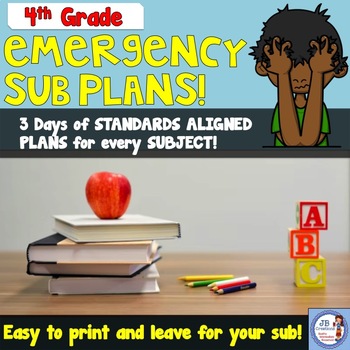
Our district actually required us to have 3 day’s worth of plans ready to go this year (we definitely are experiencing a sub shortage in our area). I wanted to make sure the resources that I would leave for my students were flexible enough to fit in at any time or place in the curriculum, but also full of meaningful learning and not just busy work. So I got busy creating!
I developed 3 days worth of Language Arts, Math, Social Studies, Science, and Morning work activities (15 activities in all!) that can be tailored to suit individual classroom needs. Complete teacher instructions are included for EVERY ACTIVITY! This makes it easy to pick and choose the subjects/activities you want to leave for any sub you may have.
I really wanted to leave activities that were engaging for my kids. Keeping that in mind, I included several class games, a reader’s theater, basic experiments, and puzzles in addition to more typical review activities.

Saturday, September 10, 2022
As the need for more specific literacy based instruction increases in the intermediate classroom, I have really stepped up my game with vocabulary in the past year or so.
It has been proven time and again that the larger a child’s vocabulary, the stronger reader they will become. But, how can we make sure our students are learning all of the necessary vocabulary they will need? How can we possibly choose the correct word lists to focus on? The simple answer is....it’s impossible! There are just too many words in the English language.
But, there is a powerful tool that you can teach your students to make that seemingly impossible mountain of words easier to attack. And that tool is MORPHOLOGY!
Simply put, morphology is the study of the most common Greek and Latin affixes (sometimes referred to as “root” words) that hold meaning. By having students learn just 1 new root’s meaning, they can later apply that to dozens of words that contain it; giving them a solid advantage when it comes to attempting to learn that new vocabulary word!
I have spent the past few years incorporating morphology into my language arts classes and have been OVERWHELMED with the success and speed with which my students have increased their vocabulary. Even more exciting is that what I am teaching them is a LIFELONG skill that will continue to help for years to come!
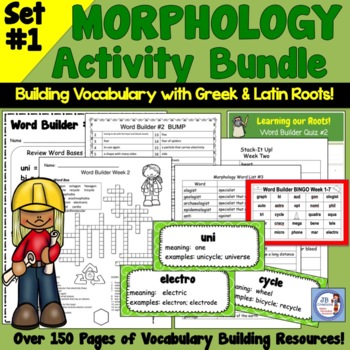
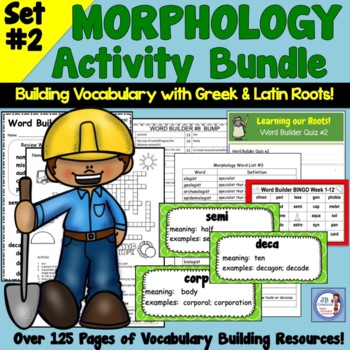
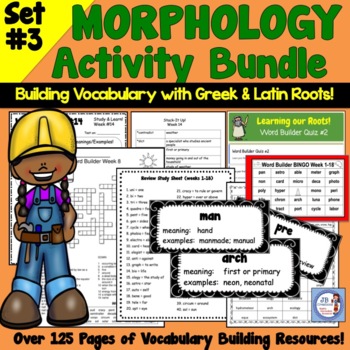
The program I have developed and designed contains 25 weeks worth of word lists, study sheets, flashcards, individual practice puzzles and activities, weekly Google Form quizzes, whole class review games, and summative assessments for each quarter. Students will learn approximately 35 new roots each 9 weeks and continue to practice previously introduced roots as well. The SPIRAL nature of this program is another one of its very effective features! By then end of the year, students will have a strong foundation on over 100 of the most common and frequently used roots!
Here is how I go about implementing my program. It typically only takes about 10-15 minutes per day of my language arts instruction time!
MONDAY: I introduce the new roots with my study sheet. We spend time reviewing the 5 “old” roots, and then really talk about the new roots for the week. I have a set of large “word wall” cards (included) that I hang up on the board for the week for them to refer to. We brainstorm together a good definition for the example words after they have learned what each root means. I will pass out a puzzle for homework to be completed by Friday.
TUESDAY: We cut out the vocabulary flashcards for the week and put them in a baggie after a quick review of the meanings. We play a few rounds of the “I have, Who has” game.
WEDNESDAY: Students will work on their “stack it up” activity independently. They may use the word cards if they choose.
THURSDAY: Based on how the students did on their independent activity on Wed, I will flexibly group students to complete 2 different activities. For the kids who need a little more practice, I will pull them back to do a vocab card match with the root cards they cut out. For the kids who have a stronger grasp of the words, I will allow them to play “BUMP” in partners.
FRIDAY: I collect their puzzle homework and have them take the Google Form quiz on their chromebooks. This is a quick, self-grading check of their understanding!
*At the conclusion of the quarter’s worth of root activities, I spend a week on reviewing all of the roots they have learned in order to give a summative assessment. I have a review sheet, a crossword puzzle, a making words activity, and a Bingo game to help them prepare!
I have divided this yearlong program into 4 sections. The first 3 are now available.....with the 4th and final segment slated to be published by the end of October 2022!
Thank you for reading!
Jennifer
Thursday, September 16, 2021
Is your upcoming teacher evaluation causing you stress? Are you worried about switching gears to align your evidence to the updated OTES 2 teacher performance Evaluation? Does the rubric just seem plain overwhelming?
I have created an updated, comprehensive evidence binder that will make your life easier as you begin to gather, sort, and organize your data!
In addition to the colorful binder covers/dividers highlighting what is needed for each domain, I have also included COUNTLESS activities, resources, Google forms, charts, logs, best strategy highlights, and so much more to make sure EVERY portion of the rubric is accounted for!
I have also provided brainstorming sheets and checklists for each domain that are packed with ideas and links to included resources that will provide you all the evidence you need!
Go show them how accomplished as a teacher you truly are!!

Thank you for taking time to learn about this!
Happy teaching! Jen
Tuesday, October 29, 2019
Tuesday Tidbit: Creating groups in a quick, fun way!
I used to be guilty of the famous words, "Find a partner to do this assignment"......and the rest of my direction-giving would be lost; as kids frantically tried to make eye contact across the room with their partner of choice.
I decided that I wanted this transition time to be a little more productive and fun. As a result, my "partner match cards" were created! I developed a set of popular "partner foods" and "partner pairs", a set of famous "trios" and a set of cards designed to form groups of 4. The concept is very simple...each kid gets a random card passed out to them and they have 1 minute to "find" their partner (or group) in the room.
Check it out below!

Partner Cards!
I decided that I wanted this transition time to be a little more productive and fun. As a result, my "partner match cards" were created! I developed a set of popular "partner foods" and "partner pairs", a set of famous "trios" and a set of cards designed to form groups of 4. The concept is very simple...each kid gets a random card passed out to them and they have 1 minute to "find" their partner (or group) in the room.
Check it out below!

Partner Cards!
Tuesday, October 22, 2019
Tuesday Tidbit: How to Make Blueberry Pancakes and See Ohio! Social Studies in Action!
If you are a primary Social Studies teacher who teaches
about natural resources, map skills, economics,
or all three (like in 4th grade!), I beg you to GET THIS BOOK! How to Make a Cherry Pie and See the USA by Marjorie Priceman.

The story begins with a girl who wants to
make a cherry pie for the first time but finds that the local cook shop is
closed. Since she will need to make all
of the pie making equipment by hand now, she decides to go on adventure across
the country to get the materials herself.
The materials include granite from cliffs in Maine to make a pastry
slab, cotton from Louisiana to make pot holders, and oil from Texas to make
plastic spoons, just to name a few. I
loved this book and its Social Studies connections SO MUCH that I decided to develop my own project for my students to
work on based on the natural resources found in Ohio. They LOVED it! I actually couldn’t believe how much the
students enjoyed this activity. And I
loved that it covered so many standards in such a fun, engaging, and meaningful
way! I even created a Google slide
template and shared it with my students so that they could attach pictures and
publish their adventure! This has
definitely been one of the my top lessons this year and I would love to share
it with you! As a thank you for visiting
my blog and taking the time to read my post on this activity, I’ve included it for
free below. I’d love to hear how it goes
in your classroom if you try it!
Tuesday, October 15, 2019
Tuesday Tidbit: Use the Season to Make Learning Fun!
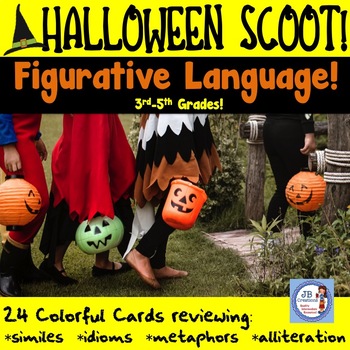
I love the holidays! And, obviously, so do the kids! Why not combine their excitement for the season with your standards and accomplish learning in a fun and connected way? I decided to do this for a recent lesson on figurative language. As I sat one night trying to make a review sheet, I was going through boring examples for similes and metaphors in my mind. Her hair was as golden as the sun. Wow, boring, right??!! As I glanced around the living room recently decorated with my favorite fall decorations, it hit me. Why not have the girl be "as sweet as a trick or treat bag full of goodies" or the night be "as black as a Halloween cat!" I immediately brainstormed a bunch of Halloween themed examples for idioms, similes, metaphors, and alliteration with a renewed sense of energy. I knew my students were going to have just as much fun reading and identifying all of my new, spookier review questions. To make it even more "fun", I decided to put my examples on individual cards to create an interactive scoot game. It didn't really take me anymore time but I know it will be so much more meaningful and fun for my students. Check it out here! (1/2 price for this week only!)
Happy Teaching! Jen
Halloween Scoot for Figurative Language
Happy Teaching! Jen
Halloween Scoot for Figurative Language
Tuesday, October 8, 2019
Tuesday Tidbit: Get and Stay Organized!
By this time of year, I have collected quite a few documents
of varying degrees of importance.
Ranging from the most basic (an updated birthday list for my class) to
more specific (who is allergic to peanuts or has an inhaler?). Instead of keeping all of these things in a
folder simply called “important papers”, I decided to be a little more organized this
year. I bought a 3 ring binder (1/2 inch
was the perfect size) and made a cute cover page with my name and class on it
to slide in the clear plastic cover.
Then I developed a set of dividers to help organize all of my papers and
information. (Feel free to use the set I
made below!)
I put these into plastic
page protectors and then put them in the order that I use them in my
folder. Finally, I went through all of
my documents, records, and papers and put them in my folder, behind the
appropriate section. This has become a
lifesaver! It sits on my desk during the
day so, at a glance, I can easily locate a child’s reading level, see who has
an upcoming birthday, or verify who is a parent pick up on Friday. At the end of the day, my binder goes in my
bag so I have email addresses, behavior records, and growth charts at my
fingertips at home. In addition, this
serves as a GREAT tool for a substitute!
No more frantically trying to remember all of the important “stuff” to
tell a sub at the last minute....I just tell them to refer to my binder! It has worked wonderfully and I just wanted
to share in case you have the same pile or folder of “important things” that is
quickly growing out of control! If you
are in need of a set of high quality organizational forms, please check out my
Beginning of Year Teacher Survival Kit! It is HALF PRICE for the week!
Happy Teaching! Jen

Subscribe to:
Posts (Atom)